The Chameleon Color and Word Challenge
Seven color and word puzzles, with the original point weights explained.
About the archived wording: percentage, rarity, IQ, timed-performance and mind-reading claims in the original copy below are fictional challenge language, not measured findings. The rules and result labels are preserved for entertainment.
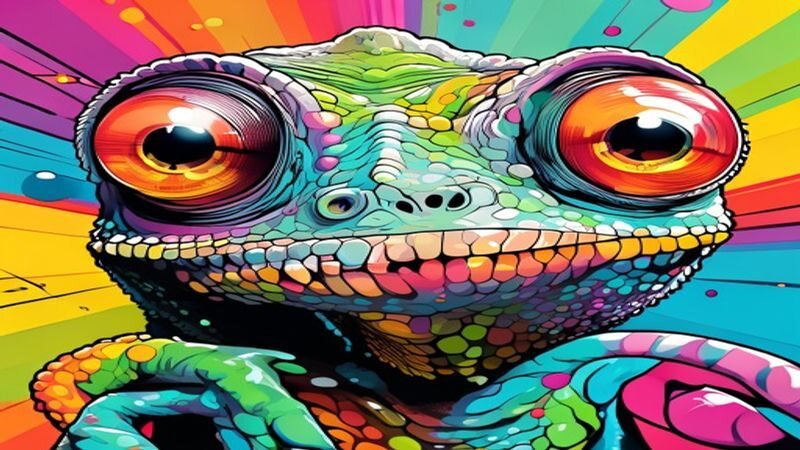
Chameleons have one job: making your eyes lie to you. This little green trickster has hidden itself inside seven color puzzles — odd shades out, letters that almost match, paint mixes that almost work — and it is frankly convinced you will fold before question five, because that is where most players do.
My money says you are sharper than the average lizard-hunter, but eyes get cocky. Read every option twice, distrust anything that looks too familiar, and go prove the reptile wrong.
Read every possible result and what it means →
Inspect the scoring, question by question
The highest possible score here is 21. The original game divides scores into 4 bands; the bands contain different numbers of answer combinations. A high point total is not a measured percentile.
1. Warm-up. One word in this row breaks the camouflage: MOSS, FERN, RUST, JADE. Which is it?
- JADE — 2 original points
- RUST — 3 original points
- FERN — 0 original points
- MOSS — 1 original points
These are the archived game’s option weights. Partial credit is a game rule, not a clinical or population measurement.
2. The chameleon lands on a lime and vanishes. Which two paints mix into that green?
- Red and yellow — 2 original points
- Blue and red — 1 original points
- White and more white, squinted at — 0 original points
- Blue and yellow — 3 original points
These are the archived game’s option weights. Partial credit is a game rule, not a clinical or population measurement.
3. An impostor is hiding in this row: TEAL TEAL TEAL TEIL TEAL. Which position is it in?
- Third — 2 original points
- Fifth — 1 original points
- Fourth — 3 original points
- The row is pure — there is no impostor — 0 original points
These are the archived game’s option weights. Partial credit is a game rule, not a clinical or population measurement.
4. October. A pumpkin patch. Our green friend needs to disappear fast — which color should it turn?
- Orange — 3 original points
- Yellow — 1 original points
- Stay green and think invisible thoughts — 0 original points
- Red — 2 original points
These are the archived game’s option weights. Partial credit is a game rule, not a clinical or population measurement.
5. Which of these fancy-sounding names is actually a shade of blue?
- Chartreuse — 2 original points
- Crimson — 0 original points
- Cerulean — 3 original points
- Sienna — 1 original points
These are the archived game’s option weights. Partial credit is a game rule, not a clinical or population measurement.
6. Compare Row A: OLIVE MINT SAGE PINE with Row B: OLIVE MINT SAGA PINE. What did the chameleon change?
- Nothing — the rows match perfectly — 0 original points
- SAGE turned into SAGA — 3 original points
- PINE and MINT swapped seats — 1 original points
- OLIVE lost a letter — 2 original points
These are the archived game’s option weights. Partial credit is a game rule, not a clinical or population measurement.
7. Final dare: in a rainbow, which color sits immediately before green?
- Blue — 1 original points
- Yellow — 3 original points
- Green goes first, actually — 0 original points
- Orange — 2 original points
These are the archived game’s option weights. Partial credit is a game rule, not a clinical or population measurement.
What happens across every possible answer pattern?
We counted all 16,384 patterns, treating each offered choice as equally likely. This is a synthetic rule check, not visitor research. It does not describe how real people answer.
| Result | Patterns | Share of patterns |
|---|---|---|
| Spotted Instantly | 323 | 1.97% |
| Half-Blended | 7,869 | 48.03% |
| One Scale Short of Legend | 7,456 | 45.51% |
| Certified Chameleon Whisperer | 736 | 4.49% |
Download the full counts · Download Python script · Download rule inputs
To reproduce locally: python3 measure_legacy.py --input legacy-rule-inputs.json --output counts.json. Uses Python 3 and its standard library.
The colour change runs on crystals, not pigment alone
For a long time the assumption was that chameleons simply shuffled pigment around inside their skin cells. In 2015 a team led by Michel Milinkovitch at the University of Geneva reported something stranger in panther chameleons: a layer of cells packed with a tidy lattice of guanine nanocrystals. Relax or tighten that lattice and the spacing between crystals changes, which changes the wavelength the skin reflects, sliding an animal from blue-green towards yellow, orange and red.
That is structural colour, the same physics behind a beetle's shell or a soap film, and it can be tuned in seconds. The researchers also described a deeper crystal layer that reflects near-infrared, which probably has more to do with heat than display.
It is a conversation, not a hiding place
The cartoon version, where a chameleon on tartan turns tartan, is not a thing that happens. Their resting greens and browns already resemble foliage, so camouflage is roughly the default state, and the dramatic changes are signals laid on top of it. Males flare into bright, high-contrast display when facing a rival or courting; a dark, drab animal is often cold, stressed or backing down.
Temperature matters too. Darker skin absorbs more heat, so a cool morning lizard has good reason to go sombre before the sun is properly up, and to lighten once it has warmed through. Species differ enormously in how much range they have, and a great many of the roughly two hundred known species barely shift at all.
The rest of the equipment is just as odd
Each eye sits in a turret of fused eyelid with a small aperture, and the two swivel independently, letting the animal scan almost all the way around itself. When something edible appears, both eyes converge on it to judge distance, and then the tongue is fired using elastic energy stored in collagen tissue, among the quicker movements any vertebrate manages.
Naming shades on a screen has nothing to do with any of this, of course. The quiz is a bit of fun wearing a lizard costume.
Reading context & limits
The cited study examines structural colour change in panther chameleons through changes in guanine nanocrystal spacing. This is not a claim that every reptile changes colour in the same way.
For background and a fuller source trail, read Why Personality Quiz Results Feel So Accurate. These references provide context; they do not validate the entertainment result or every historical detail in the archived essay.
- Photonic crystals cause active colour change in chameleons — Nature Communications
- Barnum Effect — Encyclopaedia Britannica
- Barnum effect — APA Dictionary of Psychology
Content lead: LISA. Updated October 25, 2026. Send a specific factual correction.