Could You Survive a Horror Game?
Seven classic horror-game decisions determine whether you see the credits or become them.
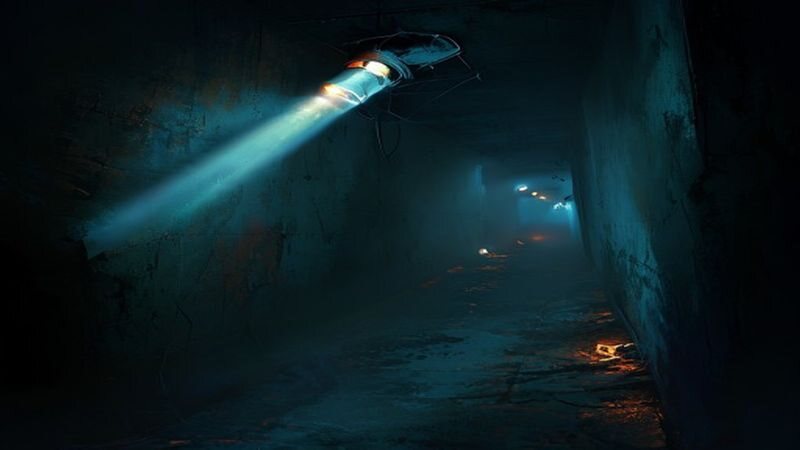
Every horror game is, underneath the fog and the ominous piano, an exam about judgment. The monster is rarely the true danger. The true danger is the part of you that hears a noise below the floorboards and thinks: interesting, I should investigate that alone, in the dark, unarmed.
Ahead sit seven of the genre's classic decisions — the abandoned mansion, the dying flashlight, the friend who suggests splitting up. Choose what you would honestly do, not what a hero would do. The game can tell the difference, and frankly, so can the basement.
Read every possible result and what it means →
Inspect the scoring, question by question
The highest possible score here is 21. The original game divides scores into 4 bands; the bands contain different numbers of answer combinations. A high point total is not a measured percentile.
1. The mansion's front door creaks open on its own. Opening move?
- Step inside, but leave the door open behind me — 1 original points
- Map every exit, take the fire poker, keep walls at my back — 3 original points
- Call out 'hello?' loudly, broadcasting my exact position — 0 original points
- Walk the perimeter first, checking windows and escape routes — 2 original points
These are the archived game’s option weights. Partial credit is a game rule, not a clinical or population measurement.
2. Your group votes to split up and 'cover more ground.' Your response:
- 'Great thinking — I'll take the basement, alone' — 0 original points
- 'Pairs minimum, fixed meeting time, agreed rally point' — 2 original points
- 'Absolutely not. We move as one slow, annoying unit' — 3 original points
- 'Fine, but the flashlight comes with me' — 1 original points
These are the archived game’s option weights. Partial credit is a game rule, not a clinical or population measurement.
3. On a dusty shelf: a tape recorder labeled PLAY ME. Do you?
- Pocket it for later — information helps, ambushes don't — 3 original points
- Immediately, at full volume, in the dark — 0 original points
- Play it quietly in a room I've already cleared — 2 original points
- Press play while keeping one eye on the doorway — 1 original points
These are the archived game’s option weights. Partial credit is a game rule, not a clinical or population measurement.
4. The flashlight begins to flicker. State your battery philosophy.
- I shake it gently and whisper words of encouragement — 1 original points
- Batteries? I've been navigating by phone at 4 percent — 0 original points
- Spares in every pocket, sorted by charge, plus a glow stick — 3 original points
- One spare set, tested before I ever came inside — 2 original points
These are the archived game’s option weights. Partial credit is a game rule, not a clinical or population measurement.
5. A ghostly child beckons you down the long hallway. What do you do?
- Decline politely and back away without turning around — 2 original points
- Follow her, obviously. Children are trustworthy, even translucent ones — 0 original points
- Evacuate the entire wing. Nothing good lives down that hallway — 3 original points
- Follow, but slowly, feeling clever about the slowness — 1 original points
These are the archived game’s option weights. Partial credit is a game rule, not a clinical or population measurement.
6. You discover a safe room with a save point. How do you use it?
- Later, probably. What's the worst that could happen — 0 original points
- Save, check inventory, plan my route, then save again — 3 original points
- Save whenever things feel spooky, which is inconsistent — 1 original points
- Save on every single visit, no exceptions — 2 original points
These are the archived game’s option weights. Partial credit is a game rule, not a clinical or population measurement.
7. Endgame: the exit is chained shut, footsteps closing in, one hairpin in your pocket.
- Work the lock with shaking hands, back pressed to the door — 2 original points
- Rattle the chain heroically and yell for help — 1 original points
- Hide, let the footsteps pass, then pick the lock in silence — 3 original points
- Turn around to face the monster. For closure — 0 original points
These are the archived game’s option weights. Partial credit is a game rule, not a clinical or population measurement.
What happens across every possible answer pattern?
We counted all 16,384 patterns, treating each offered choice as equally likely. This is a synthetic rule check, not visitor research. It does not describe how real people answer.
| Result | Patterns | Share of patterns |
|---|---|---|
| First Jumpscare Casualty | 323 | 1.97% |
| The Act Two Cliffhanger | 7,869 | 48.03% |
| The Late-Game Veteran | 7,456 | 45.51% |
| The Final Survivor | 736 | 4.49% |
Download the full counts · Download Python script · Download rule inputs
To reproduce locally: python3 measure_legacy.py --input legacy-rule-inputs.json --output counts.json. Uses Python 3 and its standard library.
A genre built on withholding
Horror games learned early that the frightening part is whatever the player cannot see or cannot do. Mid-1990s titles popularised survival horror as a marketing phrase, and the design underneath it was largely subtraction: fixed camera angles framing a corridor while hiding whoever walked down it, ammunition counted in single digits, saves rationed by consumable items, and controls stiff enough that turning to run felt like a decision with weight. Tension came from arithmetic as much as from atmosphere.
A later wave went further and removed the weapon altogether. Hiding in a wardrobe, nursing a torch battery and memorising the route to a door produce a different fear, one in which competence itself is withheld and the only tools are patience and a good grasp of the floor plan.
Why being frightened is enjoyable
Psychologists have a name for the appetite: benign masochism, the phrase Paul Rozin used for the human habit of enjoying experiences the body reads as threatening while the mind knows it is safe. Chilli, terrifying films and fairground ghost trains all trade on that gap. Games add agency, which sharpens both the dread and the relief.
A jump scare is the cheapest instrument in the orchestra. The startle reflex is easy to trigger and impossible to sustain, so durable work is done by audio and pacing: silence held slightly too long, a sound placed just outside the light, footsteps whose direction stays ambiguous. Some studios build pacing systems that watch the player and schedule the quiet stretches deliberately, a technique Valve documented at length when describing the director software governing the flow of its co-operative zombie shooter.
The ones who die are usually the ones in a hurry
Anyone who has finished a few of these games will tell you the survival skills are unglamorous: search rooms before the noise starts, spend resources early instead of hoarding them into uselessness, and learn the exits before you need them. Panic wastes ammunition and forgets doors. What a set of hypothetical choices cannot establish is how anybody behaves with real adrenaline in the bloodstream, which is exactly the sort of claim worth testing against whoever swears they would never open the basement door.
Reading context & limits
For background and a fuller source trail, read Why We Love Being Scared. These references provide context; they do not validate the entertainment result or every historical detail in the archived essay.
- Rozin et al., Glad to be sad, and other examples of benign masochism (2013)
- Playing With Fear: A Field Study in Recreational Horror — PubMed
Content lead: LISA. Updated October 25, 2026. Send a specific factual correction.