Character brief builder
Give a fictional character a role, a contradiction and an opening situation. Your selections write the brief, not your name.
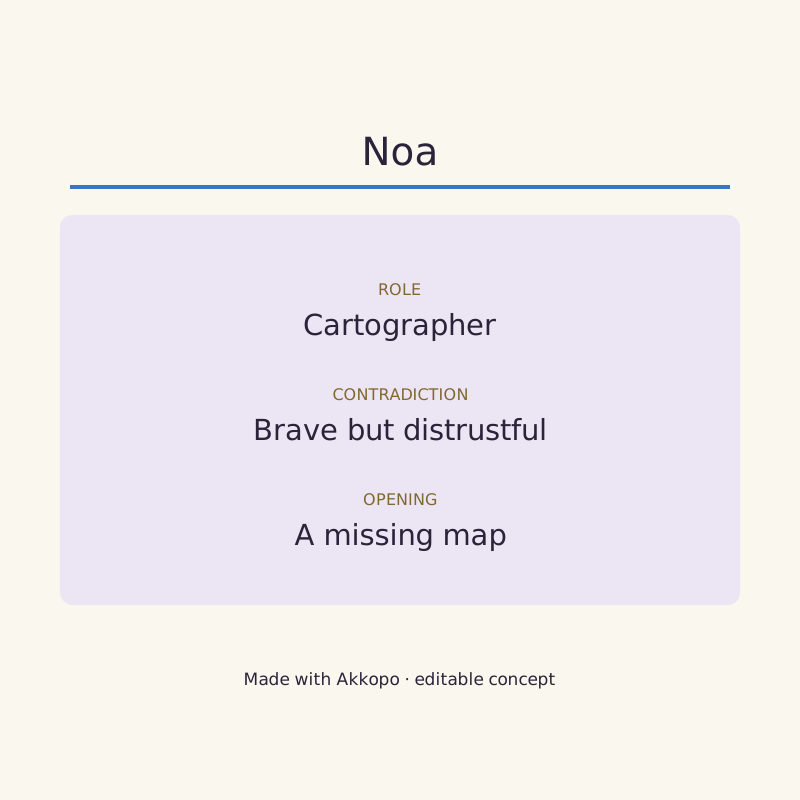
Character brief builder
Give a fictional character a role, a contradiction and an opening situation. Your selections write the brief, not your name.
Try a second version
Use the contradiction to choose an action. Instead of calling the character brave, show the risk they accept and what they refuse.
All changes and downloads happen in your browser. Nothing you type is sent to us. SVG downloads can be edited in a vector editor; the text download keeps your choices and notes.
The original word-to-result game
The archived game below selects a preset fictional result. It is separate from the design tool above and cannot measure rarity, predict a future or reveal another person’s feelings.
About the archived wording: percentage, rarity, IQ, timed-performance and mind-reading claims in the original copy below are fictional challenge language, not measured findings. The rules and result labels are preserved for entertainment.
Names talk, if you know how to listen. In this line of work we run them through the machine, and out comes a second life: a title sequence, a signature move, a flashback rendered in slow rain. Yours has been sitting in the archive for years, fully storyboarded, waiting for somebody to pull the file.
Type whatever you actually answer to — given name, nickname, the alias your barista knows. The machine matches your letters to the alter ego they've been sheltering, complete with a role, a power, and a fate. Cue the opening theme.
Read every possible result and what it means →
Fan vocabulary crossed the ocean before the dictionaries did
English-speaking anime fandom built its own terminology because nobody else was supplying one. Through the 1980s and early 1990s series circulated in North America and Europe as tape copies passed hand to hand around university clubs, occasionally carrying subtitles produced by fans who had begged access to editing equipment. When home internet arrived the same work moved online and became very much faster.
Words travelled with the tapes. Tsundere, describing a character whose prickliness conceals affection, became widely used in Japanese online communities in the early 2000s and reached English-language forums within a few years, with no official translation involved at any point. Moe, a considerably harder term to render, arrived by the same route. Fans were effectively drafting a critical vocabulary in public, argued over post by post, long before any publisher thought to define it.
Archetypes are production tools before they are jokes
Character types persist because they solve problems in production. An ensemble built from contrasting temperaments gives writers instant friction in any pairing, which is cheap drama in the best sense. Distinct silhouettes and colour schemes let a viewer identify who is on screen in a single frame, which matters when budgets favour held poses and reused sequences. A recognisable type also tells an audience how to feel about a newcomer without spending an episode establishing it.
The trade-off is obvious, and the medium knows it perfectly well. A large share of the better-regarded series work by setting up a familiar type and then breaking it, and that only lands because the audience walked in with the template already installed.
Letters are letters
It is a pleasant fantasy that a name conceals a second self. Japanese naming does allow a genuine extra layer, since written characters can be selected for sense as well as sound, and translators regularly have to decide whether to preserve that or let it quietly go. Nothing comparable is hiding inside an English first name, however long you stare at it.
So treat the alter ego below as fiction written for a stranger, because that is what it is. The pick is arithmetic and the description was drafted before anyone knew you existed. The pleasure is entirely in whether it flatters you and whether the people who know you agree.
Reading context & limits
For background and a fuller source trail, read How a Meme Actually Spreads. These references provide context; they do not validate the entertainment result or every historical detail in the archived essay.
Content lead: LISA. Updated October 25, 2026. Send a specific factual correction.