A tiny deep-sea pressure lab
Use one simple rule to explore what changes as a vessel descends.
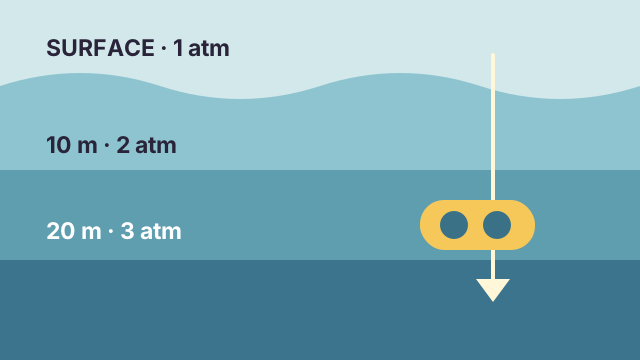
Imagine lowering an instrument through seawater. For this quiz, use a simplified classroom rule: the surface pressure is 1 atmosphere, and every 10 meters adds approximately 1 atmosphere. The arithmetic is intentionally approximate; actual water density and local conditions matter.
NOAA’s explanation of pressure with depth supplies the physical background. The invented instrument readings below let you apply that relationship in different ways. This is a numerical model for learning, not a diving table, operating instruction, or safety calculation.
Give it a go
0 of 5 answered
Answers, with the working
Open an explanation whenever you like. Looking at the reasoning is part of learning, not a rule violation.
01 Using our rule, what is the approximate total pressure at 20 m?
Answer: 3 atmospheres
Start with the surface atmosphere and add two more for twenty meters: 1 + 2 = 3. The word “total” matters. The water adds about two atmospheres, but the instrument also experiences the pressure already present at the surface.
02 Our instrument moves from 10 m to 30 m. How much pressure does that change add?
Answer: 2 atmospheres
The depth increases by twenty meters, adding roughly two atmospheres under the stated model. The total pressures would be two and four atmospheres respectively, and their difference is two. A change in pressure is not the same quantity as the final pressure.
03 The model predicts 6 atmospheres in total. At what depth is the instrument?
Answer: 50 m
Subtract the one atmosphere already present at the surface. The remaining five atmospheres come from five ten-meter intervals, giving fifty meters. Solving backward is a good check of whether you included the starting value rather than treating zero depth as zero pressure.
04 At 20 m the total is 3 atmospheres. At 40 m, does doubling depth double total pressure?
Answer: No: it becomes 5
At forty meters the model gives 1 + 4 = 5 atmospheres. The water contribution doubles from two to four, but the surface contribution stays one. A relationship with a nonzero starting value need not double its total when the input doubles.
05 Which is the best label for these answers?
Answer: Approximate results of a stated model
The answers belong to the model given in the introduction. Its rounded increment is useful for understanding a relationship, but it omits details needed for real operations. A good numerical answer includes the scope of the calculation, not just a confident-looking number.
Plot the starting point
Draw depth on the horizontal axis and total pressure on the vertical axis. Mark (0, 1), (10, 2), (20, 3), and (30, 4). The points lie on a straight line in this simplified model. Crucially, the line begins above zero. That starting value explains the doubling question without any complicated mathematics.
Make a second line for the added water pressure alone: (0, 0), (10, 1), (20, 2). Comparing the two lines shows how a fixed starting contribution changes totals while leaving differences unchanged. This is a reusable idea in many simple models.
Background and boundaries
NOAA explains that hydrostatic pressure increases with ocean depth and gives about one additional atmosphere for every 10.06 meters. We deliberately rounded that to ten meters for manageable arithmetic. All instrument situations are original hypothetical examples, not measurements from an expedition.
Sources & scope
Reference checked October 24, 2026. Examples and explanations were written for this quiz.
Something unclear? Suggest a correction.