Small-space layout sketcher
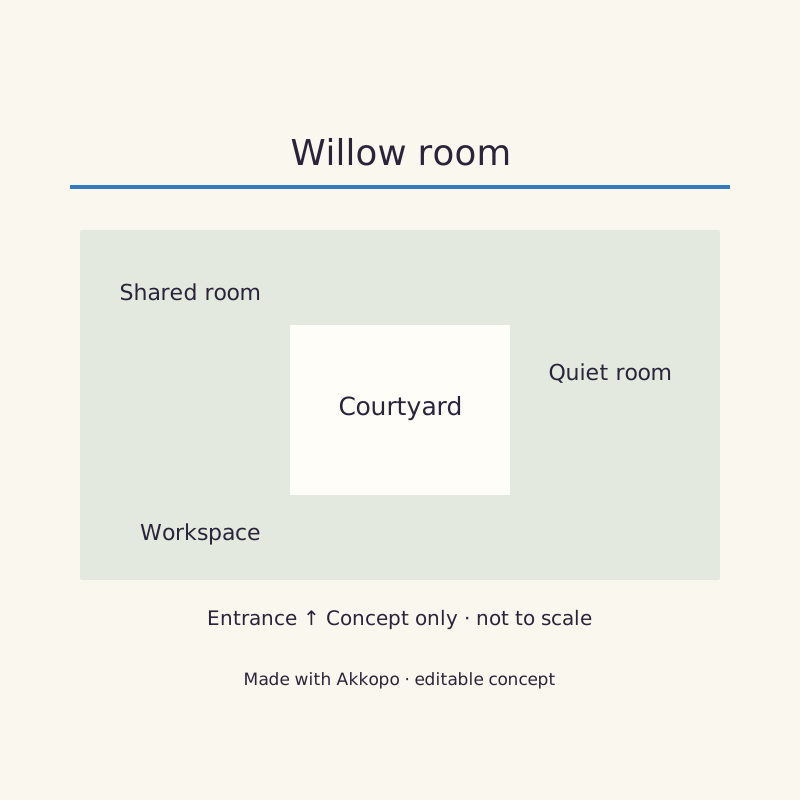
Arrange a simple room diagram around a courtyard, an open plan or separate rooms. Compare how circulation changes.
Small-space layout sketcher
Arrange a simple room diagram around a courtyard, an open plan or separate rooms. Compare how circulation changes.
Try a second version
This is a concept sketch, not a building plan. Trace a route from the entrance to the workspace without crossing a private room.
All changes and downloads happen in your browser. Nothing you type is sent to us. SVG downloads can be edited in a vector editor; the text download keeps your choices and notes.
The original word-to-result game
The archived game below selects a preset fictional result. It is separate from the design tool above and cannot measure rarity, predict a future or reveal another person’s feelings.
About the archived wording: percentage, rarity, IQ, timed-performance and mind-reading claims in the original copy below are fictional challenge language, not measured findings. The rules and result labels are preserved for entertainment.
Give us a name and we will hand back a floor plan. Somewhere between the letters and the way they lean, there is a doorway, a favorite window, and a kitchen that already smells like you. We read the shape of it and start drawing.
What you get is a house tour, room by room, matched to the personality your name carries. Walk through it slowly. Notice which corner you would claim first and which you would never leave. Then take the postcard at the end and mail it to the group chat.
Read every possible result and what it means →
Climate did the designing long before architects did
Most of the buildings humans have ever lived in went up without an architect, using whatever lay within a short cart ride. The results are far from random. Where days are hot and nights cold, walls are thick and windows small, because mass takes up heat slowly and gives it back slowly. Where rain and snow are heavy, roofs are steep. Where ground floods, floors go up on posts. Courtyard houses appear independently across North Africa, the Middle East and China because an inward-facing plan buys shade, still air and privacy in a single move. There is a whole field devoted to this, vernacular architecture, and it is essentially the study of intelligent constraint.
Houses had names and signs before they had numbers
Street numbering is a fairly recent administrative habit. For most of urban history a dwelling was identified by its sign, its owner or a nearby landmark, so an address was a sentence rather than a code. Systematic numbering spread across Europe during the eighteenth century, often for reasons unrelated to the post: the numbers assigned in Vienna in 1770 existed so that the state could count households for military conscription. Claims about the very first numbered street, usually placed in Paris, are disputed and rest on thin evidence. In parts of Britain and Ireland the older habit never died out, and rural homes still carry names instead of digits.
The cottage look is younger than it pretends
An ivy-covered cottage feels ancient, but the aesthetic owes a great deal to the picturesque enthusiasms of the eighteenth and nineteenth centuries, when the cottage orne turned a labourer's dwelling into a style for people who had never laboured. Rough walls, studied asymmetry and rustic porches were choices, not accidents. Thatch is genuinely old, mind you: it insulates well, and surveys of roofs in the English West Country have found base layers of straw surviving beneath centuries of re-thatching.
At the other extreme, the glass house on a cliff is a modernist proposition roughly seventy-five years old, and its most celebrated examples are notoriously hard to heat and cool. Every house offered here is a mood rather than a plan, but each of those moods came from somewhere real.
Reading context & limits
For background and a fuller source trail, read Why Personality Quiz Results Feel So Accurate. These references provide context; they do not validate the entertainment result or every historical detail in the archived essay.
Content lead: LISA. Updated October 25, 2026. Send a specific factual correction.