A fair puzzle needs more than a clever answer
How we test a question for hidden assumptions, competing answers, and a useful explanation.
Start with the disagreement
Suppose a puzzle shows 2, 4, 8 and asks for the next number. Sixteen is a familiar answer, but “familiar” and “uniquely determined” are different claims. A rule that adds successive even numbers gives 2, 4, 8, 14. Both rules fit the supplied terms. If a quiz awards a point only for sixteen, the writer has left an assumption unstated.
Our repair is small: say “double each term.” The puzzle becomes less mysterious but more checkable. It can still test whether a player counts positions correctly or applies an operation consistently. Fairness does not require making every question easy; it requires making the criterion visible.
Separate the story from the constraints
Write a draft question as two lists: the scene and the facts needed to solve it. A café can be charming, but the arithmetic may need only a price, quantity, and discount. If tax is irrelevant, exclude it explicitly. If a route must follow grid streets, say so. Otherwise a reader can supply a reasonable alternative that changes the answer.
Try removing each sentence in turn. If the answer changes or becomes ambiguous, the sentence carries a constraint. If it does neither, it is atmosphere. Atmosphere has a place, but a critical condition should not be buried inside a joke that readers are encouraged to skim.
Write the explanation before the wrong answers
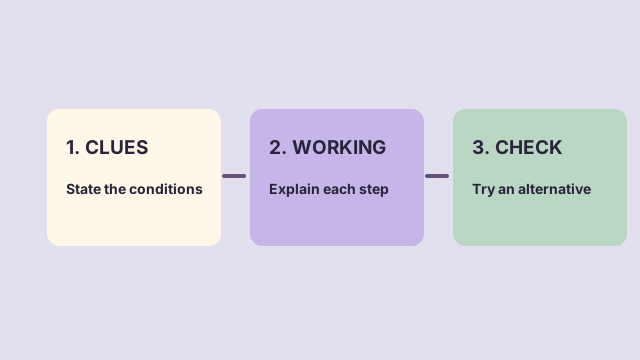
For the three-book puzzle, the explanation is a chain: the atlas must be in the middle; the diary must therefore be on the left; the novel occupies the right. Each step uses a stated condition. If you cannot write that chain without adding information, the question is not ready.
Only then write the distractors. A useful wrong answer reflects a specific misunderstanding: counting an object twice, ignoring a starting value, or reversing a condition. A random absurd option may make a question easier without teaching anything. On Akkopo, an incorrect option receives zero points in knowledge quizzes; being a plausible mistake does not make it partly correct.
Test the strongest alternative
Do not ask only whether your answer works. Ask whether another answer could also work under the exact wording. For the cabinet key, a steel spare is a counterexample to the claim that every working key must be brass. The original rule says all brass keys work; it never rules out other materials.
A counterexample is a compact quality check because it needs only one legitimate alternative. You do not need to prove that readers will choose it often. If it obeys the conditions and contradicts your answer key, the key or wording must change.
Keep a repair record
When a question is corrected, record what changed and why. A wording fix that removes a competing interpretation is more informative than a silent date update. Our corrections page records published changes, and the contact route asks readers to include the page address and disputed question.
This article describes the construction method used for the examples on this site. It does not claim that every ambiguity has been eliminated or that an automated check substitutes for human review. The practical standard is narrower: a reader should be able to inspect the reasoning and point to the exact place where they disagree.
These scenarios and worked examples were written for Akkopo. Reasoning is shown on this page; fictional situations are not presented as observed data.