What your quiz score can—and cannot—say
A worked example of raw scores, percentages, and the missing evidence behind percentile claims.
Five correct answers are a count
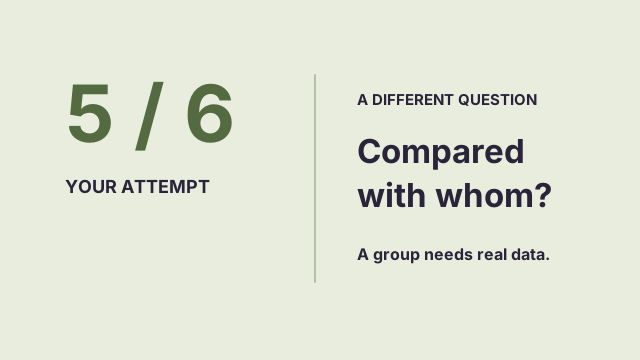
If you answer five of six questions correctly, the raw score is five. Dividing by six produces about 83.3 percent correct. Both statements describe your attempt. Neither statement tells us what share of other people you outperformed, because no other people’s results have entered the calculation.
This distinction sounds simple until a result page says “top 1%” beside a short quiz. A percentile requires a defined comparison group and data from that group. Without those ingredients, an impressive label is decoration rather than measurement. Akkopo does not collect attempts or publish visitor percentile rankings.
A tiny invented comparison
Imagine a practice group with five scores: 2, 3, 3, 4, and 5 out of five. A score of four is higher than three of the five listed scores. If another group records 4, 4, 5, 5, and 5, the same four is higher than none. The raw performance is unchanged; the comparison changed.
These are invented numbers for explanation, not observations of our readers. Even with real data, a report would need to explain how ties are handled and who was included. Different conventions can produce different percentile labels from the same list. Showing the underlying data and definition is more useful than a polished badge.
Question choice changes the meaning
A perfect score on familiar arithmetic and a perfect score on an unfamiliar rulebook are both perfect within their own sets. They need not imply the same skill, difficulty, or preparation. A five-question collection samples very little, and repeated attempts can reward memory for the answer key.
For that reason, our results point back to the explanations. If you missed a unit conversion, the useful next action is to inspect the units, not to adopt a global label about your ability. A result should make the underlying task easier to understand rather than turn a narrow attempt into an identity.
Partial credit needs a reason
A wrong answer can reveal partial understanding, but a scoring rule has to say what is being rewarded. Giving a plausible wrong option two points and a less plausible wrong option one point may make the total look precise without a clear interpretation. For our knowledge quizzes, the rule is intentionally simple: correct earns one; incorrect earns zero.
That choice does not imply partial-credit systems are always bad. A worked solution with several independently checkable steps can justify them. Our multiple-choice pages do not observe those steps, so they do not pretend to measure them.
Read the result as a map of this attempt
After finishing, compare one correct answer you felt uncertain about with one incorrect answer you felt certain about. The explanations may reveal different things: a successful guess, a misunderstood word, or a calculation made from the wrong starting value. That is more actionable than comparing yourself with an unspecified crowd.
Nothing here estimates intelligence, health, professional competence, or suitability for a role. The score records a set of responses under a published answer key. Its limits are part of its meaning, not fine print to hide beneath a celebration.
These scenarios and worked examples were written for Akkopo. Reasoning is shown on this page; fictional situations are not presented as observed data.