A rulebook you can test on one sheet of paper
An original tabletop exercise for discovering ambiguous rules before they cause an argument.
Build a deliberately tiny game
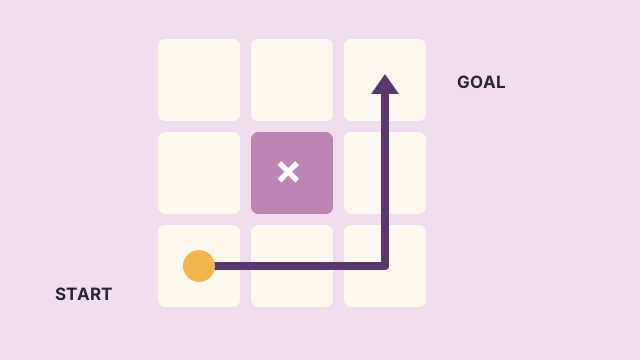
Draw a three-by-three grid. Put a token at the lower-left corner and mark the upper-right corner as the goal. The token may move one square horizontally or vertically on each turn, staying within the grid. No diagonal moves, walls, or other pieces exist. This is a complete enough model to ask a few precise questions.
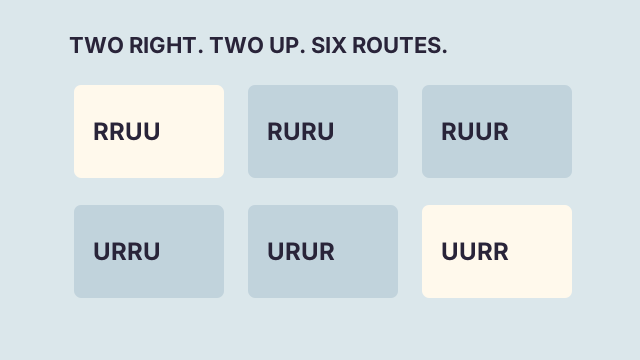
The shortest route uses four moves: two right and two up, arranged in some order. The route RRUU differs from RURU even though both start and end in the same places. We will count routes by their sequence of moves, not by the number of squares they visit.
List the six shortest routes
The complete list is RRUU, RURU, RUUR, URRU, URUR, and UURR. Every shortest route contains exactly two R moves and two U moves. Choosing the two positions occupied by R among four positions gives six possibilities. You can check each sequence directly on your grid.
This is a small original enumeration, not a simulation of a commercial game. It gives you a transparent answer key for testing a change to the rules. A larger board might call for a program, but on this board the full set fits in a paragraph.
Now block the center
Add one new rule: the center square cannot be entered. Four of the six shortest routes pass through the center. RRUU and UURR go around the outside and remain legal, leaving two shortest routes. Trace them rather than relying on the visual impression that the obstacle must block half the choices.
The order of operations matters when comparing versions. First define what counted as a route in the original game. Then apply the new restriction to each candidate. If you change both the movement rule and the obstacle at once, it becomes harder to identify why a route disappeared.
Find an ambiguity on purpose
Replace “move one square” with “move up to two squares.” Can the token stop without moving? Can it turn between the first and second square? Can it jump over the blocked center? The new sentence does not settle all of those questions. Different reasonable readings create different games.
Repair the wording according to your intent. For example: “Take one or two consecutive orthogonal steps. You may turn between steps. Each entered square must be inside the grid and unblocked.” If passing is allowed, add it explicitly instead of hoping everyone shares the same convention.
Use examples as miniature tests
Keep one legal example and one illegal example beside each important rule. A legal right-then-up move demonstrates turning. A rejected move through the center demonstrates that crossing a blocked square is not allowed even if the endpoint is clear. These examples make a rule easier to verify than a general promise that it is intuitive.
This exercise is about clarity, not optimizing a game for competition. A real game can deliberately include uncertainty, negotiation, or hidden information. The key is to make those features intentional rather than accidental consequences of a sentence that leaves essential behavior unspecified.
These scenarios and worked examples were written for Akkopo. Reasoning is shown on this page; fictional situations are not presented as observed data.