Would you catch the rulebook loophole?
Six tabletop situations where the exact wording makes the move.
The game does not exist. The rules do, and they are all printed in the questions. That means experienced players get no secret advantage from recognizing a commercial title. Read each scenario as a tiny rulebook of its own.
Some choices are legal but unhelpful; others sound sensible but are not allowed. We ask only what follows from the rules given. Ignore conventions from your favorite games unless the question explicitly includes them.
Give it a go
0 of 6 answered
Answers, with the working
Open an explanation whenever you like. Looking at the reasoning is part of learning, not a rule violation.
01 A turn allows “up to two moves.” How many moves may you choose?
Answer: Zero, one, or two
“Up to” sets a maximum, not a minimum. With no separate requirement to move, zero, one, and two are all allowed. If a designer intends at least one move, the rule needs to say so. Good rules writing makes the intended lower bound as clear as the upper bound.
02 A card says “draw two cards, then discard one.” Your hand starts with 3 cards and the deck is sufficient. How many remain?
Answer: 4
Drawing two raises the hand from three to five. Discarding one leaves four. The net change is plus one, but the intermediate five-card hand could matter if another rule checked hand size during the turn. Here no such rule exists, so only the stated sequence applies.
03 A bridge allows a piece to cross only if it carries a key. A piece has a key. Must it cross?
Answer: No
“Only if” gives a requirement for crossing. It does not order every qualified piece to cross. Having a key makes that condition available; it does not choose the action. Confusing permission with obligation is a common source of disagreements around otherwise simple rules.
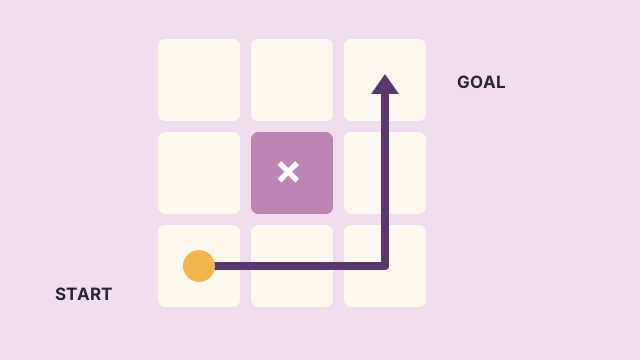
04 A token may move one square horizontally or vertically, never diagonally. Can it reach the diagonally adjacent square in exactly two moves?
Answer: Yes
One horizontal move followed by one vertical move reaches the diagonally adjacent square. The destination is diagonal relative to the start, but neither individual move is diagonal. The restriction applies to each move, not to the combined displacement, and no obstacles are stated.
05 Ties are broken by fewest coins. Ari and Bo both have 10 points; Ari has 3 coins and Bo has 5. Who wins?
Answer: Ari
The points tie, so the stated tie-break applies. Three coins are fewer than five, giving Ari the win. Familiarity can work against you here: many games reward more resources, but this invented rule rewards fewer. Use the rule in front of you rather than the one you expect.
06 A round ends when the deck is empty. The last card is drawn, leaving no cards. Does this rule alone say to finish everyone’s turn?
Answer: No
The rule gives an end condition but no instruction to complete remaining turns. Adding a fairness convention might be a sensible house rule, but it is an addition. Distinguish the written behavior from an improvement you would propose to the designer.
Separate legal, required, and useful
A move can be permitted without being compulsory or strategically good. The key puzzle isolates permission, while the hand-size puzzle isolates sequence. Keeping these concepts separate makes it easier to explain a disagreement without accusing another player of ignoring the rules.
If a rule is ambiguous, write two short examples that lead to different interpretations. A designer can then resolve a concrete situation rather than argue about a vague phrase. The same technique helps when reading instructions for a tool or a shared activity.
Make one rule clearer
Rewrite “up to two moves” for a game where passing is forbidden. “Take one or two moves” is short and explicit. Now imagine a blocked player who has no legal moves: would the game need an exception? Small wording changes can reveal missing cases before anyone starts playing.
These scenarios and worked examples were written for Akkopo. Reasoning is shown on this page; fictional situations are not presented as observed data.
Something unclear? Suggest a correction.