Why a style quiz should be allowed to tie
We enumerated all 1,024 answer patterns in a five-question, four-style model. Here is what happens.
The question we actually tested
Our five-question style quizzes offer four choices per question. Each choice adds one vote to one of four fictional styles, and the largest vote count determines the result. It is tempting to assume that an odd number of questions prevents a tie. That would be true for two styles, but it is not true for four.
We tested the scoring structure by enumerating every possible answer pattern. Five questions with four options each produce 4 × 4 × 4 × 4 × 4 = 1,024 patterns. These are constructed combinations, not visitor responses and not a survey.
The result: 360 tied patterns
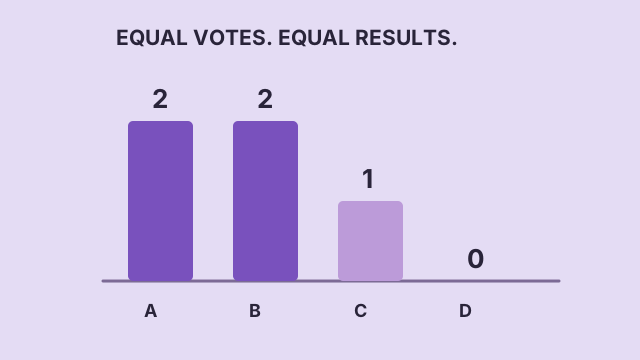
A tied maximum can have the vote shape 2, 2, 1, 0, in any order across the four styles. Choose the two leading styles in six ways, choose which remaining style receives the single vote in two ways, and arrange the five responses in 5! ÷ (2! × 2!) = 30 ways. Multiplying 6 × 2 × 30 gives 360.
The other 664 patterns have a single leading style. Dividing 360 by 1,024 gives 35.15625 percent of the enumerated pattern space. This is not a prediction that 35.15625 percent of readers will tie. That prediction would require assumptions about how people choose answers, including their dependence across questions.
What an invisible tie-break would do
A program that selects the first largest count would assign every tied pattern to whichever leading style appears first in its list. The final label would look decisive even though the visitor gave the two styles equal support. Alphabetical order or database order would silently affect the story.
Randomly choosing between leaders avoids favoring the first label, but it still hides an important fact: the answers did not produce a unique leader. It can also make a repeated attempt with identical answers appear inconsistent. Neither behavior is necessary for this kind of entertainment quiz.
Our design choice
Akkopo displays every tied leading style and shows the vote totals for all styles. A five-question pattern of 2, 2, 1, 0 therefore produces two equally presented descriptions. A reader can compare the suggestions rather than accept a hidden technical decision as a personal insight.
We do not describe the voting model as psychological measurement. The enumeration tests the logic of a toy scoring rule. It cannot validate the style names, establish reliability, or prove that the choices describe a stable trait. Those are different questions requiring different evidence.
Reproduce the calculation
The downloadable CSV lists all 1,024 patterns, the vote count for each style, and the number of leaders. The public Python script generates that file using only the standard library. You can count rows with more than one leader or change the number of questions and rerun the experiment.
This study was first generated on October 24, 2026. It contains no personal data. The six-question quest quiz has a different pattern space and is not covered by the 35.15625 percent figure. Its browser tests separately verify that two-way and three-way ties are displayed correctly.
These scenarios and worked examples were written for Akkopo. Reasoning is shown on this page; fictional situations are not presented as observed data.