Color palette studio
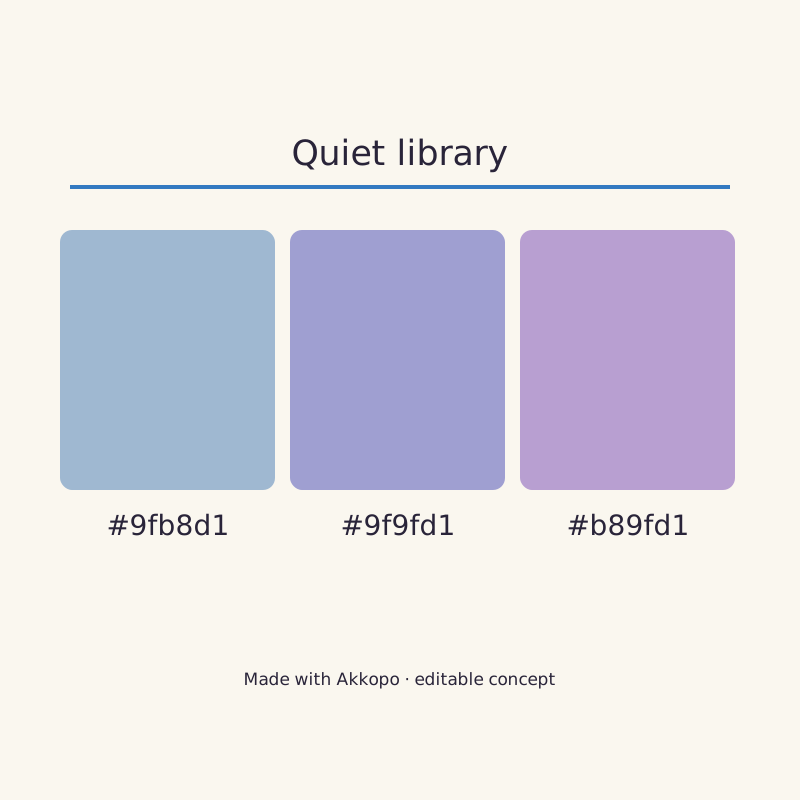
Build a three-color palette and check text contrast. Your choices set the colors; a name only labels the artwork.
Color palette studio
Build a three-color palette and check text contrast. Your choices set the colors; a name only labels the artwork.
Try a second version
Compare the light and dark text ratios before using the palette. Change one control at a time to see which decision changes the output.
All changes and downloads happen in your browser. Nothing you type is sent to us. SVG downloads can be edited in a vector editor; the text download keeps your choices and notes.
Read the W3C contrast criterion. The numeric check covers foreground/background contrast only, not all accessibility requirements.
The original word-to-result game
The archived game below selects a preset fictional result. It is separate from the design tool above and cannot measure rarity, predict a future or reveal another person’s feelings.
About the archived wording: percentage, rarity, IQ, timed-performance and mind-reading claims in the original copy below are fictional challenge language, not measured findings. The rules and result labels are preserved for entertainment.
Picture your name as sound and shape rather than letters, and something curious happens: it starts to look like a color. Not one you would find in a paint aisle, but a soft blend that only your name could mix.
Type it below and let the blend settle. What comes back is a mood more than a shade, a small portrait of how you move through a day. It is playful, it is generous, and yes, it is completely unscientific. That is exactly why it is fun.
Read every possible result and what it means →
Some people genuinely see letters in colour
Grapheme-colour synaesthesia is the carefully studied case in which letters and digits reliably carry colours for the person perceiving them. Prevalence estimates shift with the method used, though figures in the low single-digit percentages are commonly reported. The standard check is not a description but a consistency test: show the same characters again months later without warning, and a synaesthete's choices match closely, whereas somebody asked to invent associations drifts badly on the retest.
The experience is idiosyncratic in its details. One person's A is scarlet, another's pale green. In aggregate, though, it is not random: across large samples, A comes out red far more often than chance would allow.
The fridge magnets that gave the game away
The neatest evidence that these pairings are partly learned came from a 2013 study by Nathan Witthoft and Jonathan Winawer. They identified a group of synaesthetes whose letter-colour matches resembled one another to an uncanny degree, and traced the pattern back to a set of coloured Fisher-Price refrigerator magnets sold in the United States from the early 1970s. Letters that had shared a colour on the fridge door shared a colour decades later in adulthood.
This does not make the condition imaginary. It suggests the underlying wiring is there and childhood supplies the particular pairings, which is a considerably more interesting account than either extreme position.
Sound already has a shape
Ask people which of two invented words, bouba or kiki, belongs to a rounded blob and which to a spiky star, and a large majority answer identically. Wolfgang Kohler reported the effect in the 1920s using different syllables, and it has since been repeated across many languages and with young children who cannot yet read. Names are built from those same sounds, so it is not entirely mad that a name feels soft or sharp before you know a single thing about the person carrying it.
Feeling like a specific colour goes a good deal further than the evidence supports. The blend produced here was written for pleasure rather than measured, which makes it an unusually pretty shrug.
Reading context & limits
For background and a fuller source trail, read Why Personality Quiz Results Feel So Accurate. These references provide context; they do not validate the entertainment result or every historical detail in the archived essay.
Content lead: LISA. Updated October 25, 2026. Send a specific factual correction.